On 26 October 2026 the European Stability Mechanism (ESM) launched its first digital bond: EUR 1,000 million whose cash leg settles in central bank money through Pontes, the Eurosystem platform. According to the Bundesbank, its issuing agent, the bond's liquidity will be supported by its planned listing on the Luxembourg Stock Exchange and its planned admission as collateral.
Europe has already shown that it can issue tokenised assets with institutional backing. What the available information does not yet allow is a comparable assessment of their secondary market. That assessment requires knowing what is tokenised, who issues it and under which authorisation, and what the markets further ahead can teach.
Key takeaways
- Issuance already works: the ESM digital bond, settled on Pontes on 26 October 2026, shows that Europe can issue tokenised assets with institutional backing.
- What is tokenised is mostly funds: as of 2 November 2026, 88% of the value of the 15 European assets with a public token measured by DAS sits in one swap-based cash fund (63%) and four money market funds (25%).
- Authorisation is not the same as supervision of the issuer: managers authorised by the AMF or the CSSF coexist with an issuer of tokenised debt with an approved prospectus that states it operates without supervision, and with seven infrastructures authorised under the DLT Pilot Regime.
- Trading is barely visible: on that date, only 2 of the 15 assets had any liquidity pool of at least USD 1,000.
- The figures measure different things: RWA.xyz separated USD 39,049 million of distributed assets from USD 397,978 million of represented assets.
- The United States and Asia show conditions, not shortcuts: the United States combines size, use as collateral and abundant tokenised money, although the data do not allow causation to be attributed; on Japan's START market, with a regulated platform and monthly statistics, real estate tokens traded less than 0.05% of their value in October.
- The gap can be closed without waiting for reform: issuers and infrastructures can already publish volume and venues, exit terms and the coverage of their data.
The figures in this analysis are those of 2 November 2026; the strip below shows the current day's figures, which the DAS Market Tracker updates daily.
What has Europe already achieved in tokenisation?
Europe issues tokenised assets with institutional backing. According to the Association for Financial Markets in Europe (AFME), EUR 3,174 million of fixed income had been issued on distributed ledger technology (DLT) up to 14 October 2026, the highest figure in its series, under a definition of Europe that includes the United Kingdom and Switzerland.
The European Securities and Markets Authority (ESMA) lists seven authorised infrastructures under the EU DLT Pilot Regime, the framework set by Regulation (EU) 2022/858 that allows financial instruments to be traded and settled on distributed ledgers with temporary exemptions. Since 30 March 2026 the ECB has accepted as collateral securities issued using DLT in central securities depositories and settleable in T2S, and Pontes has operated since 21 September.
None of these decisions settles what happens to the assets once they have been issued.
Which assets are being tokenised in Europe?
As of 2 November 2026, 88% of the value of the 15 European assets with a public token measured by DAS sits in two kinds of fund: the swap-based cash fund eurSAFO (63%) and four tokenized money market funds (25%), according to the DAS classification of RWA.xyz data.
The remainder is spread across private credit, active strategies, US Treasury bills, gold and shares of exchange-traded funds. For the investor, each type implies a different underlying asset, supervisor and exit route.
| Asset type | Examples in the sample | Value on 2 Nov 2026 | Observable exit route |
|---|---|---|---|
| Swap-based cash fund | eurSAFO (Spiko) | USD 1,804 million (63.1%) | Redemption with the fund |
| Tokenized money market funds | EUTBL, USTBL, UKTBL (Spiko); Franklin Templeton's Luxembourg fund | USD 716 million (25.1%) | Redemption with the fund |
| Private credit | mGLO and mGLOBAL (Midas) | USD 223 million (7.8%) | Redemption with the issuer |
| US Treasury bills | mTBILL (Midas) | USD 73 million (2.5%) | Redemption with the issuer |
| Active strategies on crypto-assets | Four Midas tokens | USD 40 million (1.4%) | Redemption with the issuer |
| Gold | VNXAU (VNX) | USD 1.5 million | Decentralised exchanges and issuer |
| Exchange-traded fund shares | Two Swarm tokens | USD 0.04 million | No trading observed |
Source: DAS Market Tracker with data from RWA.xyz, GeckoTerminal and KyberSwap. The types follow the DAS classification, which differs from RWA.xyz's: the latter places eurSAFO among Active Strategies. The exit route describes what the tracker can observe, not the full contractual terms of each product. The sample covers assets whose issuer or vehicle is domiciled in the European Economic Area (EEA), not those merely offered there: this is why, for example, Backed's certificates, issued from Jersey under a prospectus approved by Liechtenstein's FMA, are excluded.
Tokenized money market funds
The tokenized money market funds in the sample are shares of regulated funds whose register of unitholders is kept, wholly or partly, with tokens. Spiko offers three, EUTBL, USTBL and UKTBL, which invest in short-term Treasury bills in euros, dollars and sterling; the fourth is Franklin Templeton's Luxembourg money market fund.
The token does not change the nature of the product: the investor holds shares in a money market fund, and the natural exit is redemption with the fund. The absence of trading on decentralised exchanges does not, on its own, indicate a liquidity problem.
The swap-based cash fund: eurSAFO
eurSAFO, the largest product in the sample with 63% of its value, is not a money market fund: according to Spiko, it is a European harmonised fund (UCITS) that invests mainly in shares of large listed companies and has a total return swap with a bank.
Under that swap, the fund passes the return on its portfolio to the bank and receives a return linked to the overnight rate plus a spread. Its prospectus does not classify it as a money market fund, and RWA.xyz places it among active strategies. For the investor the difference is concrete: the risk of a Treasury bill fund lies mainly with the states that issue the bills; the risk of eurSAFO lies also with the swap counterparty and with the portfolio behind the swap.
Private credit, active strategies and Treasury bills: Midas
Midas accounted for USD 336 million on 2 November 2026, 11.7% of the sample, across private credit, US Treasury bills and active strategies on crypto-assets. Its base prospectus, approved by Liechtenstein's FMA on 17 July 2026, covers, among others, mTBILL, mHYPER, mAPOLLO and mBASIS: subordinated, perpetual debt instruments governed by Swiss law and issued by the Berlin company Midas Software GmbH. With these tokens the investor does not own the strategy's assets but holds a claim on the issuer.
The two private credit tokens, mGLO and mGLOBAL, are linked to a credit strategy run by Fasanara Capital, but they do not appear in that prospectus, and DAS has not verified their regime.
Gold and exchange-traded fund shares
VNXAU, VNX's gold token, was worth USD 1.5 million on 2 November 2026 yet accounted for 90% of the volume observed on decentralised exchanges over the previous thirty days. Swarm offers two tokens that track shares of US Treasury bond exchange-traded funds, worth about USD 39,000 combined.
Tokenised money in euros
Euro stablecoins totalled EUR 753.6 million on 2 November 2026 according to DefiLlama, 0.28% of the supply of dollar-pegged stablecoins, which is about 350 times larger. Circle's EURC held 59.9% and SG-Forge's EURCV 22.6%.
Who issues, who supervises and who holds a licence?
As of 2 November 2026, three situations coexist in the European tokenised market: fund managers authorised by their national supervisor, an issuer of tokenised debt with an approved prospectus that states it operates without supervision, and infrastructures with specific authorisation to trade or settle on distributed ledgers.
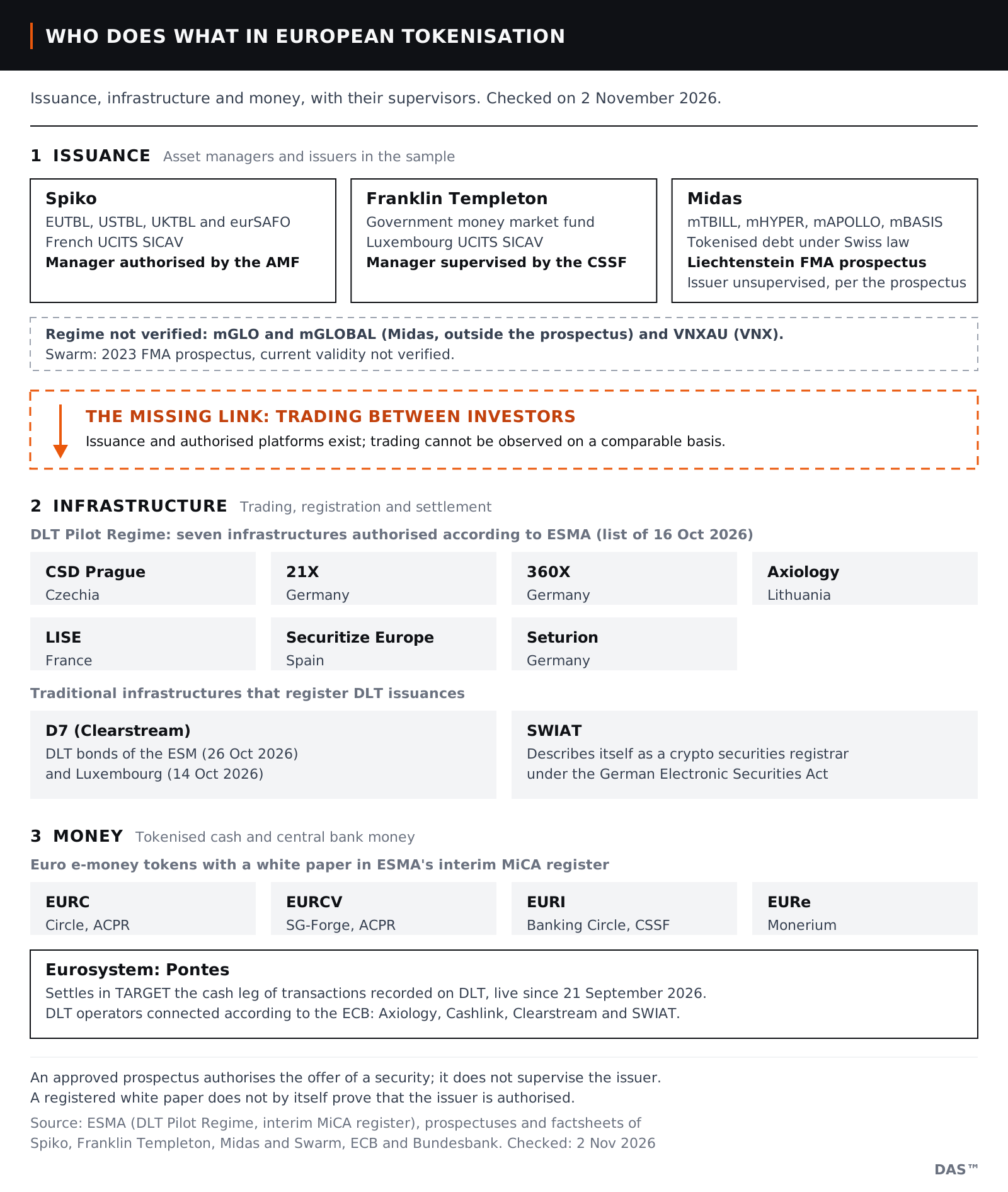
| Issuer | Products | Legal form | Authority and document |
|---|---|---|---|
| Spiko | EUTBL, USTBL, UKTBL, eurSAFO | Sub-funds of a French UCITS SICAV; the first three are short-term money market funds | Management company Twenty First Capital, authorised by the AMF; Amundi, delegated manager of eurSAFO |
| Franklin Templeton | Franklin OnChain U.S. Government Liquidity Fund | Sub-fund of a Luxembourg UCITS SICAV, public debt money market fund | Manager supervised by the CSSF |
| Midas | mTBILL, mHYPER, mAPOLLO, mBASIS | Tokenised debt under Swiss law, German issuer | Base prospectus approved by Liechtenstein's FMA on 17 July 2026 and notified to BaFin, the CNMV and others; the issuer states that it needs no licence |
| Midas | mGLO, mGLOBAL | Tokens linked to a Fasanara Capital strategy | Regime not verified: not in the base prospectus |
| Swarm | Two tokens on exchange-traded funds | Issuer SwarmX GmbH | Prospectus approved by Liechtenstein's FMA in February 2023; current validity not verified |
| VNX | VNXAU | Not verified | Regime not verified by DAS in the FMA register |
Sources: Spiko SICAV prospectus (4 May 2026), Amundi, Franklin Templeton fund factsheet (30 September 2026, in Spanish), Midas prospectus and Swarm announcement (21 February 2023).
The distinction matters: an approved prospectus authorises the offer of a security; it does not supervise the issuer. Midas's prospectus was approved by the FMA and notified to other supervisors, but the prospectus itself states that the issuer needs no licence and operates without supervision by any regulatory authority.
Trading and settlement infrastructures
| Infrastructure | Type | Authority | Authorised |
|---|---|---|---|
| CSD Prague | DLT settlement system | Czech National Bank | 11 Oct 2024 |
| 21X | DLT trading and settlement system | BaFin | 3 Dec 2024 |
| 360X | DLT multilateral trading facility | BaFin | 29 Apr 2025 |
| Axiology | DLT trading and settlement system | Bank of Lithuania | 9 Jul 2025 |
| LISE | DLT trading and settlement system | ACPR | 13 Oct 2025 |
| Securitize Europe Brokerage and Markets | DLT trading and settlement system | CNMV | 26 Nov 2025 |
| Seturion (Stuttgart Stock Exchange) | DLT trading and settlement system | BaFin | 16 Oct 2026 |
Source: ESMA list of DLT Pilot Regime infrastructures, version of 16 October 2026.
An authorisation shows what an infrastructure may do, not how much it does. DLT bonds are also recorded outside this list: the ESM bond and the EUR 1,700 million ten-year sovereign bond that Luxembourg issued on 14 October 2026 were created on D7, Clearstream's DLT platform, and SWIAT, which describes itself as a crypto securities registrar under the German Electronic Securities Act, appears alongside Axiology, Cashlink and Clearstream among the DLT operators connected to Pontes, according to the ECB. These bonds are placed with institutional investors and are not part of the 15-asset sample; the DAS inventory of DLT debt issuance is in the institutional section of the tracker.
Euro stablecoin issuers
| Token | Issuer | Authority | White paper in ESMA's interim register |
|---|---|---|---|
| EURC | Circle Internet Financial Europe | ACPR (France) | Yes |
| EURCV | Société Générale-Forge | ACPR (France) | Yes |
| EURI | Banking Circle | CSSF (Luxembourg) | Yes |
| EURS | Stasis | No data | Not listed |
Source: ESMA interim MiCA register, file of e-money token white papers, consulted on 2 November 2026. The register also lists those of Monerium (EURe), StablR, Quantoz, Schuman Financial and AllUnity; a listed white paper does not on its own establish that the issuer is authorised. Nor does Stasis's absence establish its status: the company stated in 2024 that it had applied for authorisation, and DAS has not located a decision. Tether withdrew EURT and closed redemptions on 27 November 2025. The daily supply of euro stablecoins is in the institutional section of the tracker.
Are European tokenised assets traded?
Trading in European tokenised assets is barely visible: as of 2 November 2026, only 2 of the 15 assets in the DAS sample had any liquidity pool of at least USD 1,000.
A liquidity pool is a reserve of assets on a decentralised exchange against which others can buy and sell. Volume traded there over thirty days equalled 0.021% of the sample's value (detail by asset). Nine assets had no pool at all; for four Midas tokens the only observable exit was the issuer's redemption window, which is primary market; VNXAU and mHYPER had pools of insufficient depth.
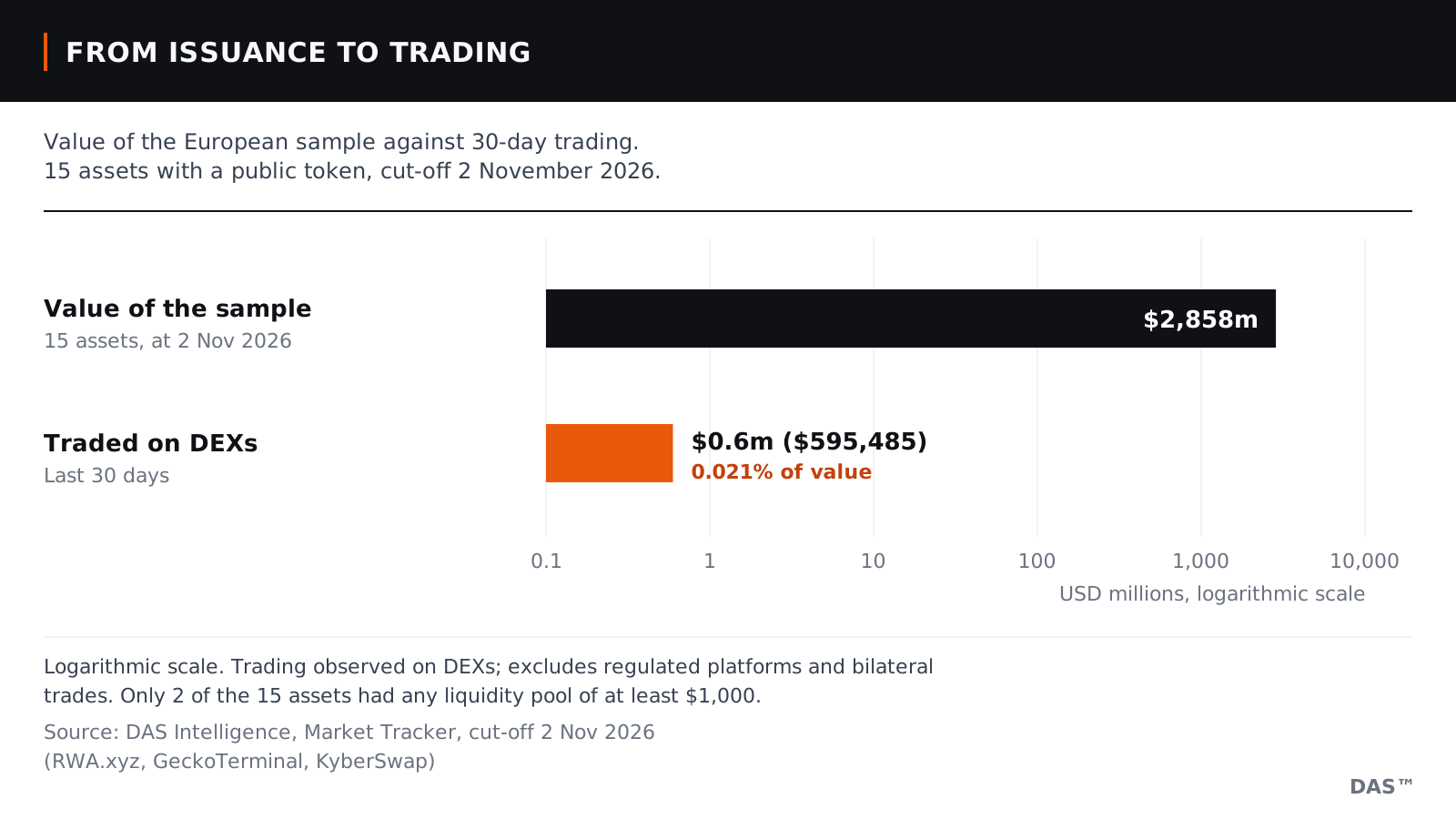
The DAS transfer classification, which adapts the method of Tümer and Mafrur, covers assets and networks representing 29% of the sample's value. Within that coverage, 91% of the amount transferred corresponds to movements consistent with token creation or destruction, or linked to the issuer. The authors, in a preprint published on arXiv on 5 October 2026, warn that this classification does not on its own establish subscriptions or redemptions.
These calculations do not consistently capture trading on regulated venues such as 21X, 360X or LISE, or bilateral trading, as the tracker methodology explains. What can be stated is that this trading is not observable on a comparable basis, not that it is absent.
Why are tokenised market figures not comparable?
Because the sources measure different categories: as of 2 November 2026, RWA.xyz distinguishes USD 39,049 million of distributed assets, which can move between wallets, from a further USD 397,978 million of represented assets, which are only recorded in a digital register.
Adding them together brings the aggregate to about USD 437,027 million. The scale changes with the category quoted. The European sample equals 7.3% of distributed assets, and the DLT bonds held in central securities depositories are not part of it.
Over the previous thirty days, the sample gained USD 176 million in value, almost all of it through growth in token supply; reading that as an inflow of money adds something the data do not say. A single issuer, Spiko, accounts for 86% of the sample. Concentration can be followed in the tracker's analysis, and each formula in its metrics dictionary.
Classification decides what a product is compared with and which risks are explained to the investor. If a Treasury bill fund and eurSAFO were grouped under one label, such as "tokenised cash", the investor would be comparing products with different risks; each product should be named for what it holds, a principle developed in the article on how to communicate tokenisation to investors, regulators and partners (in Spanish).
What does the US tokenised market show?
According to RWA.xyz, on 2 November 2026 there were USD 14,207 million in 119 tokenized Treasury products (tokenised products that invest in US Treasury debt), the largest class of distributed assets with 36% of the total.
Within that class, the products in the European sample (USTBL, Franklin Templeton's Luxembourg fund, mTBILL and the Swarm tokens) accounted for 2%: same source, same date, same class. The largest were Ondo's USDY, Circle's USYC and BlackRock's BUIDL, each above USD 2,000 million.
The framework is advancing through concrete steps. On 28 January 2026, staff from three divisions of the Securities and Exchange Commission (SEC) published a statement on tokenized securities, which is not a position of the Commission, distinguishing securities tokenised by the issuer from those tokenised by third parties; it is analysed in the article on tokenised securities according to the SEC (in Spanish). The SEC then approved Nasdaq trading securities in tokenised form, proposed modernising the rules for transfer agents and adopted a temporary exemption for platforms trading tokenised listed equities, which does not extend to Treasury funds. Payment stablecoins have their own statute, the GENIUS Act, of July 2025.
These funds have documented secondary uses, for which DAS has not located volume figures. Binance has accepted BUIDL as off-exchange collateral since 14 November 2025, and since 11 February 2026 Securitize Markets, a broker-dealer registered with the SEC, has allowed BUIDL to be traded through UniswapX by means of requests for quotes to authorised market makers, only between pre-qualified investors.
Three documented differences accompany the gap in size, although the data do not allow each one's share to be attributed. The first is tokenised money: the supply of dollar stablecoins, USD 298,294 million, is about 350 times that of euro stablecoins, USD 841 million. The second is use as collateral on trading venues, documented for BUIDL. The third is the vehicle: BUIDL is a British Virgin Islands fund privately placed with qualified purchasers, according to its Form D, and USDY and USYC are offered outside the United States; the European funds in the sample are harmonised funds, subject to their own distribution regime.
What have Singapore, Hong Kong and Japan done?
Japan offers the clearest case of regulated secondary trading in tokenised assets with published statistics: in October 2026, the nine real estate tokens on the START market, run by the ODX platform, traded about JPY 35 million against a market value of about JPY 105,400 million, according to its monthly report (in Japanese).
ODX opened START on 25 December 2023 as an authorised proprietary trading system (PTS), a category under Japanese financial instruments law. Retail investors access it through participating securities firms, and the Japanese industry association JSTOA counted 25 security token issues between April 2025 and March 2026.
In Hong Kong, the most significant step for trading came from the securities regulator (SFC): since 20 April 2026 it has allowed, under a pilot, authorised tokenised funds to be traded on licensed virtual asset trading platforms. The government's digital green bonds, the latest issued in September 2026, are mostly listed on the Hong Kong stock exchange, but the announcements do not describe trading of the tokens.
Singapore has prioritised common frameworks: the Monetary Authority (MAS) launched Project Guardian in May 2022 and in November 2024 published common frameworks for tokenised fixed income and funds.
Japan and Hong Kong share two requirements for regulated secondary trading: a platform authorised for those assets and investor access through licensed firms. Japan adds a warning: with both in place, START's real estate tokens traded less than 0.05% of their market value in October.
What can be extrapolated for tokenisation in Europe?
The United States combines size, use as collateral and abundant tokenised money, although the data do not allow the development of its market to be attributed to any one of those factors. Japan shows the other side: a regulated platform and licensed firms make trading possible, but do not generate volume on their own.
The US data and the European sample share source and date; the Japanese and Hong Kong data come from their own platforms and supervisors, with other definitions. With that caveat, the first reading for Europe is that where an asset is issued determines the exit the investor will have. The ECB accepts as collateral securities issued using DLT in central securities depositories and settleable in T2S that meet its eligibility criteria; for the ESM bond, the Bundesbank refers to planned admission. A DLT register that does not meet those conditions falls outside that announcement.
The second is that the seven Pilot Regime infrastructures can offer what the Japanese case shows to be necessary for observing trading: a platform, rules and statistics. The third, for supervisors, comes from the SFC pilot: opening trading in authorised tokenised funds on licensed platforms within a bounded regime.
The report "The European tokenised market: the decisions that will shape 2031" argues that the first infrastructures to combine scale and legal certainty will attract a disproportionate share of liquidity, setting out the counter-arguments and the indicators for testing the hypothesis from 2027; today's data neither confirm nor rule it out.
What objection does this reading face?
The main objection is that secondary markets follow issuance: on 4 December 2025 the Commission proposed widening the limits of the Pilot Regime (COM(2025) 943), and the ESM bond can move from the DLT register to T2S, conventional securities settlement.
In funds, moreover, the exit may depend on redemption, with its notice periods and conditions, rather than on finding another buyer. Tokenised issuance can rely on conventional secondary markets; what matters is identifying where each instrument actually trades and on what terms an investor can exit it.
What should issuers, infrastructures and supervisors publish?
For every tokenised asset offered to European investors, three items should be published regularly: the volume traded and on which venues, the exit terms, including redemption periods, and the coverage of the data disclosed.
On 26 October the ESM stated where it expects to support the liquidity of its bond. Issuers and infrastructures can publish these data now; for the Pilot Regime infrastructures, volume under a common definition would demonstrate activity, not merely authorisation. Supervisors can request them in a common format so that investors compare products and venues on the same basis. And investors, before judging the liquidity of a tokenised asset, need to know what it holds, with whom and within what period it is redeemed, and on which venues it trades and with what published volume.
Tokenising an asset changes neither its legal nature nor its economic risk, although it adds the risks of the technology and of custody: since the amendment introduced by Regulation (EU) 2022/858, a financial instrument issued by means of DLT, such as a tokenised security, remains a financial instrument for the purposes of MiFID II, as the guide to asset tokenisation (in Spanish) explains. Article 24(3) of Directive 2014/65/EU (MiFID II) requires investment firms to ensure that information addressed to clients is fair, clear and not misleading. Low trading volume is not, on its own, enough to conclude that a statement is misleading. Promising liquidity without explaining the actual exit mechanisms, by contrast, is a communication error and, for those subject to that rule, may also be a regulatory risk.
Four analyses (in Spanish) develop each part of this route: tokenised money market funds and who issues them, the EU DLT Pilot Regime and its limits, tokenised bonds issued in Europe and whether tokenised assets are liquid.
Frequently asked questions
What is the European tokenised market?
There is no single definition. The sample measured by DAS brings together financial assets with a public token whose issuer or vehicle is domiciled in the European Union or the European Economic Area: mostly money market funds and one swap-based cash fund, alongside tokens on government debt, private credit and gold. DLT bonds held in central securities depositories, such as the ESM's, are measured separately.
How much is the European tokenised market worth according to the DAS sample?
As of 2 November 2026, the 15 assets in the sample measured by DAS totalled USD 2,858 million, 7.3% of the distributed assets counted by RWA.xyz; Spiko accounted for 86%. This is not the value of the whole market: it excludes DLT bonds held in central securities depositories.
What are tokenized money market funds?
They are regulated money market funds whose register of unitholders is kept, wholly or partly, with tokens. The investor holds shares with their own prospectus and redemption regime, which is the usual exit route; in Europe they are offered by Spiko and Franklin Templeton, among others.
Are tokenised assets liquid?
It depends on the asset and its exit route. As of 2 November 2026, volume traded on decentralised exchanges equalled 0.021% of the value of the sample measured by DAS. For many funds the documented exit is redemption with the fund or the issuer, subject to its notice periods, and trading on regulated venues is not published on a comparable basis.
What is the difference between transferring and trading a tokenised asset?
A transfer is any movement of tokens between addresses: a token creation or destruction, an internal transfer or a movement by the issuer. Trading is buying and selling between investors at a price. This is why the volume transferred does not measure liquidity, and classifying transfers does not on its own establish subscriptions or redemptions.
What is the EU DLT Pilot Regime?
It is the framework set by Regulation (EU) 2022/858, applicable since March 2023, that allows authorised infrastructures to trade and settle financial instruments on distributed ledgers with temporary exemptions. ESMA lists seven authorised infrastructures, and the Commission's December 2025 proposal to widen its limits is still going through the legislative process.
Which euro stablecoins have a white paper registered under MiCA?
As of 2 November 2026, ESMA's interim register lists the white papers of the main euro stablecoins, including EURC (Circle), EURCV (SG-Forge), EURI (Banking Circle) and EURe (Monerium), as well as those of StablR, Quantoz, Schuman Financial and AllUnity. A listed white paper does not on its own establish that the issuer is authorised. Stasis (EURS) is not listed, and Tether withdrew EURT and closed its redemptions in November 2025.
Why is the US tokenised market larger than Europe's?
The data do not allow it to be attributed to a single cause. Three documented features accompany it: a supply of dollar stablecoins about 350 times that of euro stablecoins, the use of funds such as BUIDL as collateral on trading venues, and vehicles privately placed with qualified investors.
Where can I find up-to-date data on the European tokenised market?
Daily data for the sample measured by DAS, with source, cut-off date and coverage, are in the DAS Market Tracker; for DLT fixed income issuance, the reference is AFME.
Víctor Ribes is the founder of Digital Atelier Solutions.
Figures as of 2 November 2026. This article is for information purposes only and does not constitute financial or legal advice, or an investment recommendation.
Free LinkedIn analysis
We analyze your profile and send you an 7-page PDF with a score, detected opportunities and a roadmap to apply improvements.
Disclaimer: This article is published for informational and educational purposes only. It does not constitute financial, investment, legal, or regulatory advice. The data and figures mentioned come from public sources and may vary. Consult a qualified professional before making investment or strategic decisions.