The European tokenised market: the decisions that will shape 2031
What changes for issuers, custodians and banks, and when they will have to decide. A report on what already works in Europe, what remains to be connected and the dates by which it pays to have a position.
With a foreword by Víctor Ribes, Founder of DAS
Europe already has the infrastructure. What it lacks is a connected market.
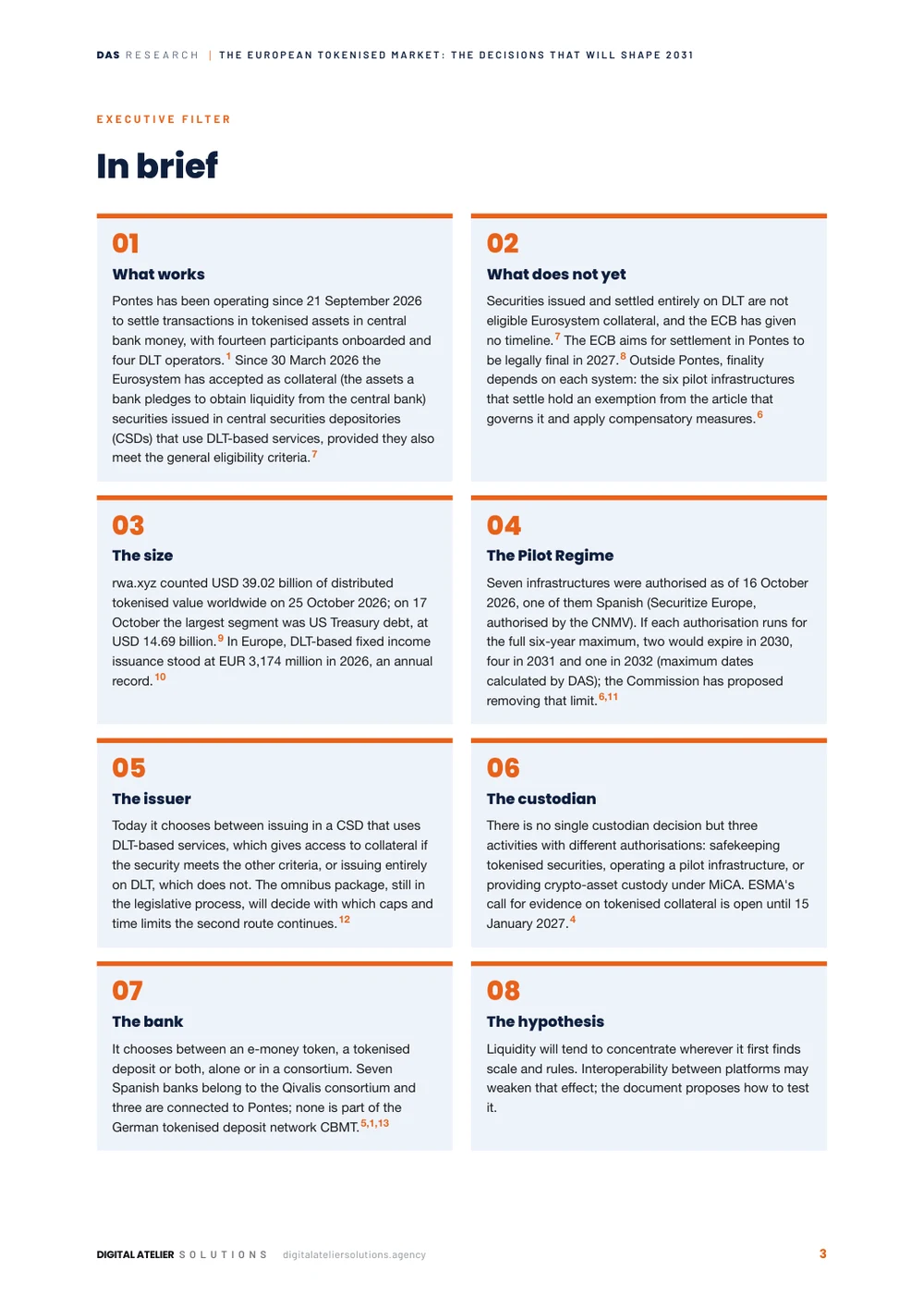
Between 21 September and 16 October 2026 the Eurosystem launched Pontes, the Commission closed its consultation on the review of MiCA, the Council moved forward on the reform of the DLT Pilot Regime, ESMA opened a call for evidence on tokenised collateral, and Qivalis and a new pilot infrastructure were authorised.
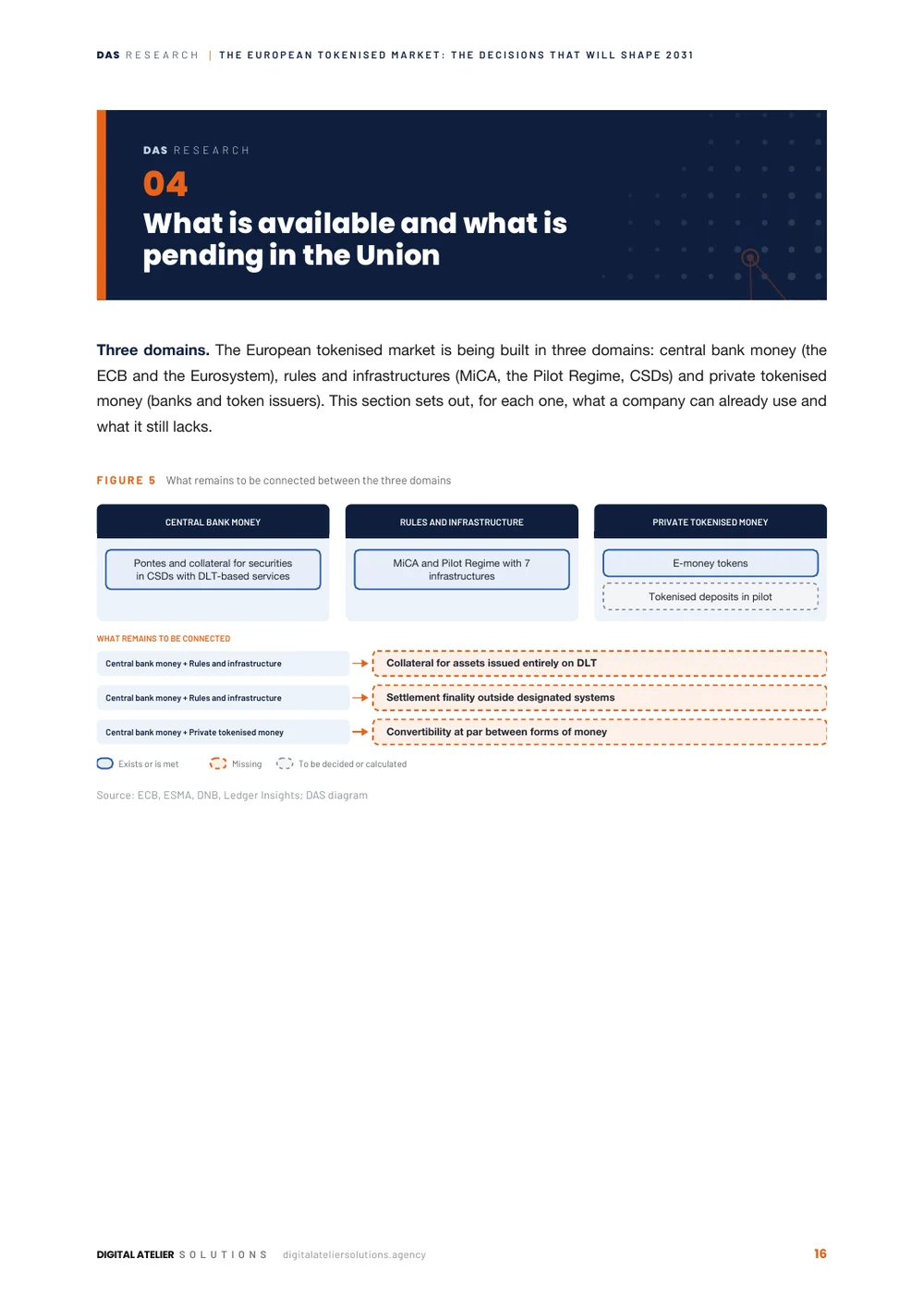
Each of those steps works on its own. The report identifies the connections still missing between them (collateral for assets issued entirely on DLT, settlement finality outside designated systems, convertibility between the forms of tokenised money) and puts forward a hypothesis: the first infrastructures to combine scale and legal certainty will attract a disproportionate share of liquidity.
The hypothesis comes with its counter-arguments and with the indicators that will make it possible to test it from 2027 onwards.
Three actors, three decisions with a date.
The issuer
Today it chooses between issuing in a central securities depository with DLT-based services, which gives access to Eurosystem collateral if the security meets the other criteria, or issuing entirely on DLT, which does not. The markets omnibus will decide with which caps and time limits the second route continues.
The custodian
It faces not one decision but three activities with different authorisations: safekeeping tokenised securities, operating a pilot infrastructure or providing crypto-asset custody under MiCA. ESMA's call for evidence on tokenised collateral is open until 15 January 2027.
The bank
It chooses between an e-money token, a tokenised deposit or both, on its own or in a consortium. Seven Spanish banks belong to the Qivalis consortium and three are connected to Pontes.
Eight sections, from evidence to decision.
Before the main body, an eight-point summary, the executive summary and the timeline at a glance. At the end, the methodology and the notes, with the source of every figure.
- 01What changed between September and October 2026
- 02The liquidity hypothesis and how to test it
- 03Comparing initiatives across eight jurisdictions
- 04What is available and what is pending in the Union
- 05The decisions of the issuer, the custodian and the bank
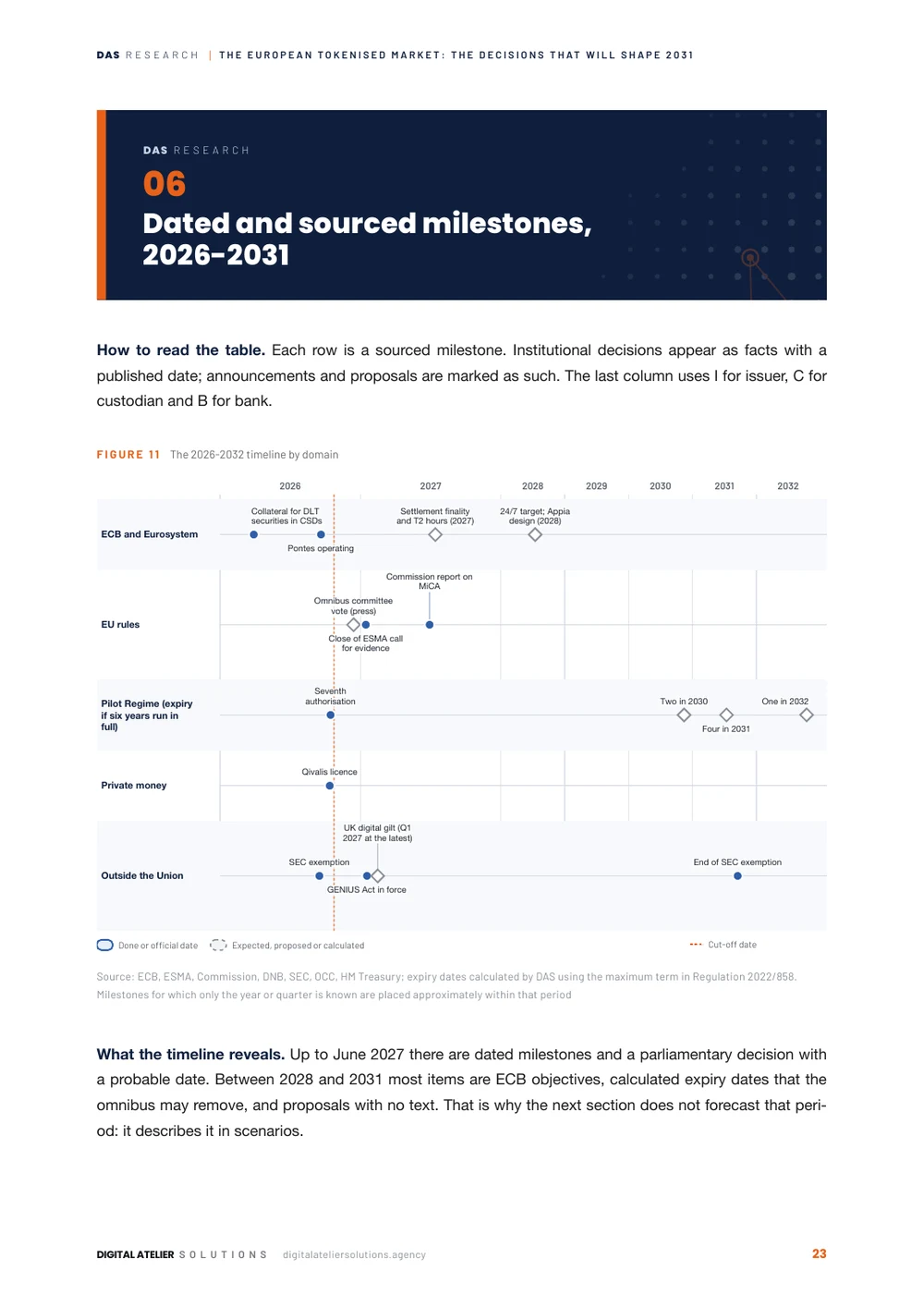
- 06Dated and sourced milestones, 2026-2031
- 07Four scenarios for 2029-2031
- 08Evidence, implications and communication
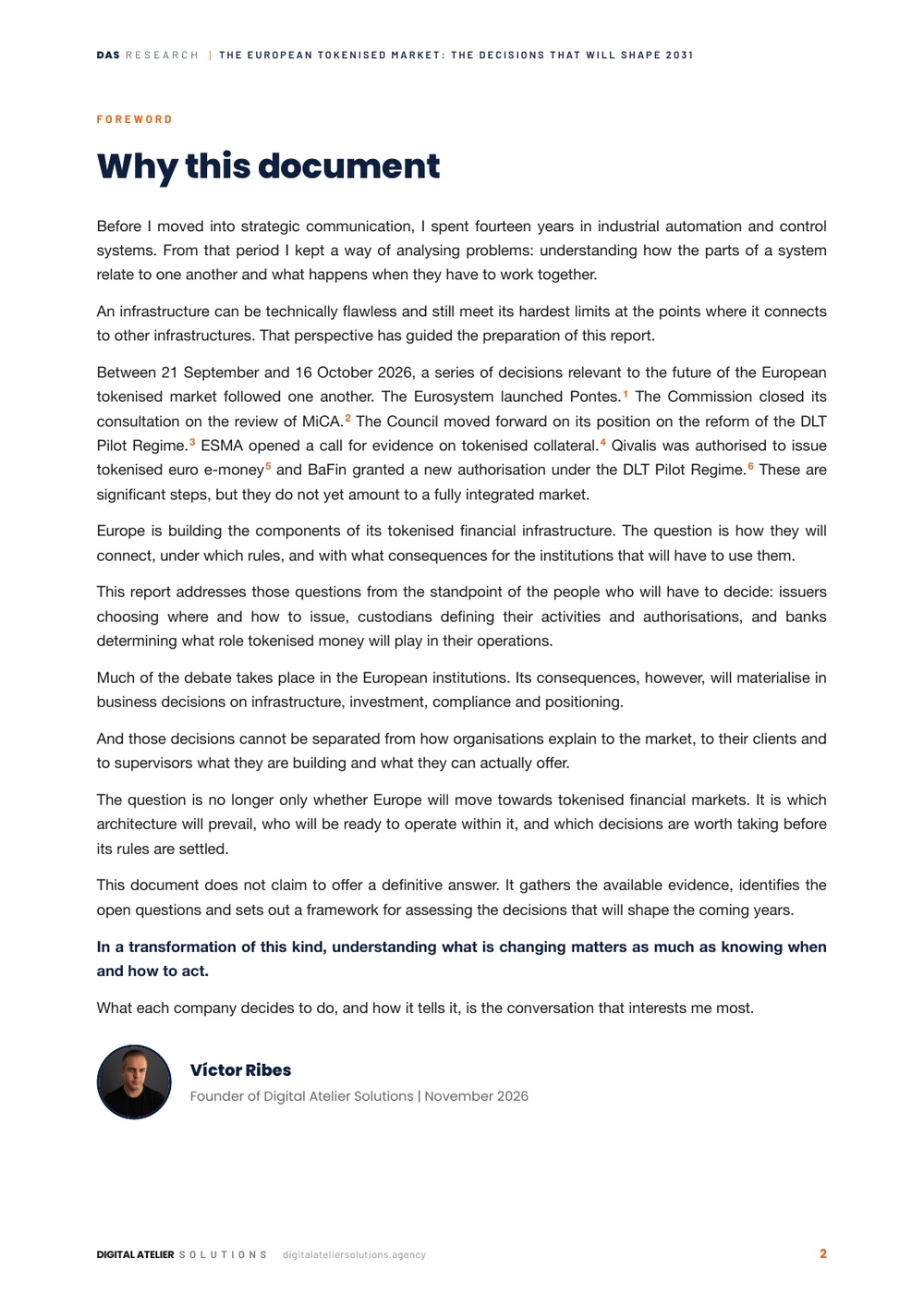
A look inside the document.
Receive it by email.
It is free. Leave your details and we will send you the PDF straight away.
- 36-page PDF, in English
- 13 figures and 3 tables, with the 2026-2031 timeline
- Four scenarios for 2029-2031 and the signals that distinguish them

Víctor Ribes
Founder of Digital Atelier Solutions
Before moving into strategic communication, Víctor spent fourteen years in industrial automation and control systems, which is where the report's approach comes from: looking at how the parts of a system connect. Active in digital assets since 2017, Víctor is also Chief Communications Officer at a company in the sector.
DAS is an executive communications firm for technology and finance, specialising in fintech, financial infrastructure and regulated sectors.
For information only. Prepared by DAS Research with public data up to 25 October 2026. It does not constitute financial, legal or investment advice and does not recommend transactions. The views in the foreword are those of its author. A Spanish edition is also available.